Pseudo Lights Out Game
A modular, state-based C program inspired by the Lights Out puzzle
Source Code:
View the project on GitHub
Overview
The Pseudo Lights Out Game is a console-based application written in C, inspired by the classic Lights Out puzzle. The project was developed to explore modular software design, state-based logic, and structured programming in a low-level language.
The program simulates a house composed of multiple windows, each represented by a binary on/off state. Users interact with the system through single-character keyboard input, toggling individual windows while the application continuously updates and displays the current system state.
Unlike the traditional Lights Out game, this implementation does not include neighbor-based toggling. Instead, it functions as a deterministic state machine in which each window is toggled independently.
Software Design
The application is organized into multiple source and header files to enforce separation of concerns:
-
main.c– Program control loop and user interaction -
house.c / house.h– House-level state management -
window.c / window.h– Individual window state and toggle logic -
ezinput.c / ezinput.h– Single-character, validated user input handling
This modular design improves readability, maintainability, and extensibility, and mirrors real-world software practices used in systems and embedded programming.
Game States
Initial State
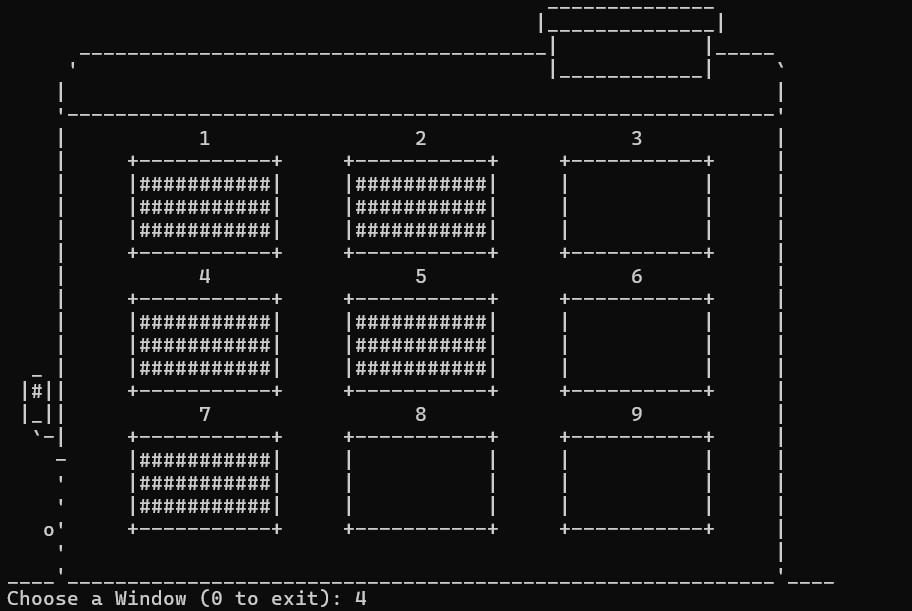
At program startup, a subset of windows is enabled, resulting in the following initial configuration:
Winning Input Sequence
While the program does not explicitly enforce a win condition in code, a “solved” state can be interpreted as all windows being turned off.
For the default starting configuration, the system reaches this solved state by toggling the following windows:
Winning input sequence: 4, 5, 7, 8, 9
Each input toggles the corresponding window’s state.
Final State
After applying the winning input sequence, all windows are turned off, resulting in the following final configuration:
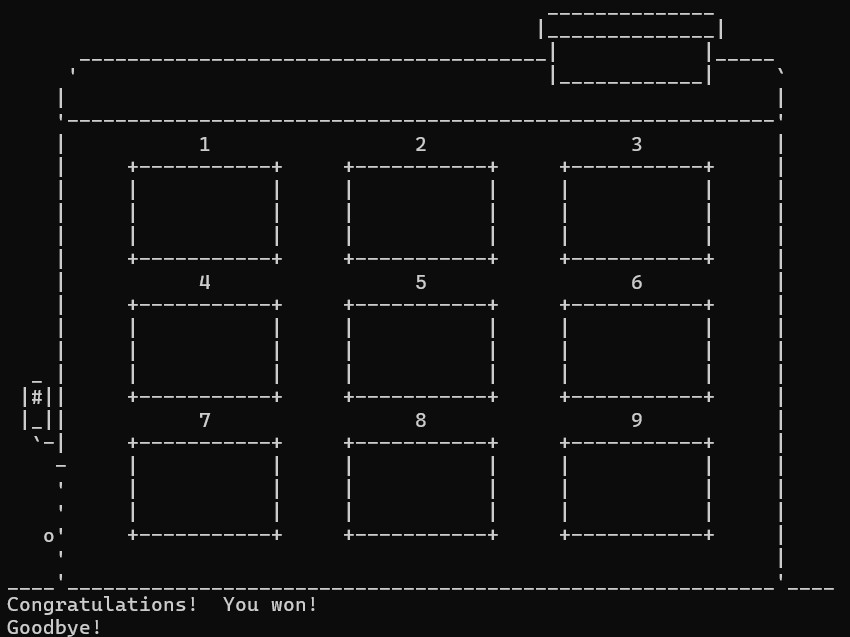
The program continues running until the user exits by entering 0.
Skills Demonstrated
- Modular programming in C using multiple source and header files
- State-machine logic and deterministic control flow
- Structured data design using
structand function-based encapsulation - Robust user input handling and validation
- Separation of concerns and maintainable software architecture
- Debugging and iterative feature development in C